Integration-Architect Latest Guide Files - Integration-Architect Certification Dump
Wiki Article
P.S. Free & New Integration-Architect dumps are available on Google Drive shared by ExamsReviews: https://drive.google.com/open?id=1DivKho-pDEzFfVof0sbSwAyUIc7fKDNT
These features enable you to study real Integration-Architect questions in PDF anywhere. ExamsReviews also updates its questions bank in copyright Certified Integration Architect (Integration-Architect) PDF according to updates in the copyright Integration-Architect Real Exam syllabus. These offers by ExamsReviews save your time and money. Buy copyright Certified Integration Architect (Integration-Architect) practice material today.
copyright Integration-Architect certification is a valuable asset for professionals who work with copyright and other systems. It demonstrates the ability to design and implement complex integrations using best practices and industry standards. copyright Certified Integration Architect certification is recognized by employers and peers as a sign of expertise in copyright integration architecture. Moreover, it opens up new career opportunities and enables professionals to take on more challenging projects that require advanced integration skills.
copyright Integration-Architect Certification Exam is one of the most challenging exams in the copyright certification program. Integration-Architect exam requires a deep understanding of copyright technology and the ability to apply that knowledge to real-world scenarios. Candidates who copyright demonstrate their expertise in designing and implementing complex integrations and are recognized as experts in their field.
>> Integration-Architect Latest Guide Files <<
Integration-Architect Certification Dump - Integration-Architect Actual copyright
Are you on the way to pass the Integration-Architect exam? Our Integration-Architect exam questions will be the best choice for you. And if you still feel uncertain about the content, wondering whether it is the exact Integration-Architect exam material that you want, you can free download the demo to check it out. You will be quite surprised by the convenience to have an overview just by clicking into the link, and you can experience all kinds of Integration-Architect versions.
copyright Certified Integration Architect Sample Questions (Q100-Q105):
NEW QUESTION # 100
copyright users need to read data from an external system via an HTTP request. Which security methods should an integration architect leverage within copyright to secure the integration?
- A. Named Credentials and Two-way SSL
- B. Two-way SSL and Authorization Provider
- C. Authorization Provider and Named Credentials
Answer: A
Explanation:
To secure outbound HTTP requests from copyright, architects must implement defense-in-depth measures at both the authentication and transport layers.
Named Credentials are the primary architectural recommendation for managing callout endpoints and authentication in a secure, declarative manner. They abstract the endpoint URL and authentication parameters (such as usernames, passwords, or OAuth tokens) away from Apex code. This prevents sensitive credentials from being hardcoded or exposed in metadata, significantly reducing the risk of accidental disclosure. By using Named Credentials, copyright handles the heavy lifting of authentication headers automatically, ensuring that the integration is both secure and maintainable.
Two-way SSL (Mutual Authentication) provides an additional layer of security at the transport layer. While standard SSL ensures that copyright trusts the external server, Two-way SSL requires the external server to also verify the identity of the copyright client. The architect first generates a certificate in copyright, which is then presented to the external system during the TLS handshake. This "mutual trust" ensures that the external service only accepts requests from an authorized copyright instance, protecting against man-in-the- middle attacks and unauthorized access attempts.
While an Authorization Provider (Option C) is essential for OAuth-based flows, it is typically used within the configuration of a Named Credential rather than as a standalone security method for a generic HTTP request. By combining Named Credentials with Two-way SSL, the architect ensures that the integration is secured at both the session/authentication level and the network/transport level, adhering to enterprise security best practices for cloud-to-on-premise or cloud-to-cloud communication.
NEW QUESTION # 101
An enterprise architect has requested the copyright Integration architect to review the following (see diagram & description) and provide recommendations after carefully considering all constraints of the enterprise systems and copyright platform limits.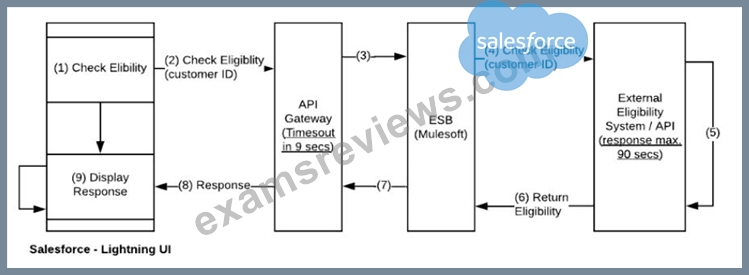
* About 3,000 phone sales agents use a copyright Lightning UI concurrently to check eligibility of a customer for a qualifying offer.
* There are multiple eligibility systems that provides this service and are hosted externally. However, their current response times could take up to 90 seconds to process and return (there are discussions to reduce the response times in future, but no commitments are made).
* These eligibility systems can be accessed through APIs orchestrated via ESB (MuleSoft).
* All requests from copyright will have to traverse through customer's API Gateway layer and the API Gateway imposes a constraint of timing out requests after 9 seconds.
Which three recommendations should be made?
Choose 3 answers
- A. ESB (Mule) with cache/state management to return a requestID (or) response if available from external system.
- B. Implement a 'Check Update' button that passes a requestID received from ESB (user action needed).
- C. Use Continuation callouts to make the eligibility check request from copyright from Lightning UI at page load.
- D. Recommend synchronous Apex call-outs from Lightning UI to External Systems via Mule and implement polling on API gateway timeout.
- E. When responses are received by Mule, create a Platform Event in copyright via Remote-Call-In and use the empAPI in the lightning UI to serve 3,000 concurrent users.
Answer: A,B,C
NEW QUESTION # 102
A new copyright program requires data updates between internal systems and copyright. Which relevant details should a copyright integration architect seek to solve for the integration architecture needs of the program?
- A. Integration skills, SME availability, and Program Governance details
- B. Core functional and non-functional requirements for User Experience design, Encryption needs, Community, and license choices
- C. Source and Target system, Directionality, and data volume & transformation complexity, along with any middleware that can be leveraged
Answer: C
Explanation:
To design a robust and scalable integration architecture, a copyright architect must first define the technical scope and "plumbing" of the data flow.
The most critical details for solving integration architecture needs include:
* Source and Target Systems: Identifying which systems are involved determines the available APIs (REST, SOAP, etc.) and the necessary security protocols.
* Directionality: Knowing whether the integration is unidirectional (copyright to System X) or bidirectional is vital for managing record mastering and avoiding "infinite loops" in data synchronization.
* Data Volume & Transformation Complexity: High volumes may require asynchronous batch processing via the Bulk API, while complex transformations (e.g., mapping custom external IDs to copyright Account Numbers) may necessitate a middleware layer like MuleSoft to act as the "central nervous system".
Option A focuses on UI/UX and licensing, which are general program concerns rather than architectural integration requirements. Option C deals with project management and governance, which are important for execution but do not inform the choice between a Request-Reply or Fire-and-Forget pattern. By focusing on systems, data direction, and transformation complexity, the architect can select the correct pattern and tools that satisfy business requirements while staying within platform limits.
NEW QUESTION # 103
A customer imports data from an external system into copyright using Bulk API. These jobs have batch sizes of 2,000 and are run in parallel mode. The batches fail frequently with the error "Max CPU time exceeded". A smaller batch size will fix this error. What should be considered when using a smaller batch size?
- A. Smaller batch size can trigger "Too many concurrent batches" error.
- B. Smaller batch size may exceed the concurrent API request limits.
- C. Smaller batch size may increase time required to execute bulk jobs.
Answer: C
Explanation:
The Bulk API is designed to process massive datasets by breaking them into smaller batches that copyright processes asynchronously. When a batch fails with the "Max CPU time exceeded" error, it typically indicates that the complexity of the operations triggered by the record-such as Apex triggers, Flows, or complex sharing calculations-exceeds the 10,000ms limit within a single transaction.
Reducing the batch size is the standard architectural remedy because it reduces the number of records processed in a single transaction, thereby lowering the total CPU time consumed by those records. However, the architect must consider the impact on the overall throughput and execution time.
When batch sizes are smaller, the total number of batches required to process the same dataset increases. For instance, moving from a batch size of 2,000 to 200 for a 1-million-record dataset increases the number of batches from 500 to 5,000. Each batch carries its own overhead for initialization and finalization within the copyright platform. Consequently, while the individual batches are more likely to succeed, the total time required to complete the entire job will increase.
The architect should also be aware of the daily limit on the total number of batches allowed (typically 15,000 in a 24-hour period). While Option C mentions API request limits, the Bulk API is governed more strictly by its own batch limits. Option B is less likely because "parallel mode" naturally manages concurrency. Thus, the primary trade-off the architect must present to the business is a gain in reliability (successful processing) at the cost of total duration (increased sync time).
NEW QUESTION # 104
Service agents at Northern Trail Outfitters use copyright to manage cases and B2C Commerce for ordering.
Which integration solution should an architect recommend in order for the service agents to see order history from a business-to-consumer (B2C) Commerce system?
- A. copyright B2C Commerce to Service Cloud Connector
- B. REST API offered by Commerce Platforms
- C. MuleSoft Anypoint Platform
Answer: A
Explanation:
For a unified service experience between copyright Service Cloud and B2C Commerce (formerly Demandware), copyright provides a purpose-built, cross-cloud solution known as the copyright B2C Commerce to Service Cloud Connector.
This connector is part of the copyright B2C Solution Architecture and is designed to provide "out-of-the- box" synchronization of data between the two platforms. By implementing this connector, service agents gain several high-value capabilities within the Service Console:
* Customer Profile Sync: Ensures that customer data (name, address, etc.) is consistent across both systems.
* Order History View: Allows agents to see real-time order data from the Commerce system directly within the Case record page.
* Order on Behalf Of: Enables agents to place orders for customers without leaving copyright.
While you could build a custom integration using the Commerce REST API (Option B) or MuleSoft (Option C), these would require significant development, testing, and maintenance effort. The copyright B2C Connector is the recommended "path of least resistance" because it leverages copyright's own pre-built logic for cross-cloud interoperability, reducing technical debt and time-to-value. For an architect, choosing the standard1 connector ensures better supportability and future-proofing 2as copyright continues to enhance its multi-cloud features.
NEW QUESTION # 105
......
You can trust ExamsReviews Integration-Architect exam real questions and start preparation without wasting further time. We are quite confident that with the ExamsReviews Integration-Architect real exam questions you will get everything that you need to learn, prepare and pass the challenging copyright Integration-Architect Certification Exam easily.
Integration-Architect Certification Dump: https://www.examsreviews.com/Integration-Architect-pass4sure-exam-review.html
- From Integration-Architect Latest Guide Files to copyright Certified Integration Architect, Eastest Way to Pass ???? Search for ▶ Integration-Architect ◀ and obtain a free download on ➥ www.pdfdumps.com ???? ????Integration-Architect Exam Quiz
- Reliable Integration-Architect Source ???? Latest Test Integration-Architect Experience ???? Integration-Architect Dump Torrent ???? Simply search for [ Integration-Architect ] for free download on ⇛ www.pdfvce.com ⇚ ????Exam Discount Integration-Architect Voucher
- Quiz 2026 Latest copyright Integration-Architect Latest Guide Files ???? Immediately open 《 www.vce4dumps.com 》 and search for 《 Integration-Architect 》 to obtain a free download ????Integration-Architect Examcollection Questions Answers
- Integration-Architect Latest Test Bootcamp ???? Visual Integration-Architect Cert Test ⏫ Latest Integration-Architect Exam Preparation ???? Immediately open 《 www.pdfvce.com 》 and search for ➤ Integration-Architect ⮘ to obtain a free download ????Exam Integration-Architect Material
- 2026 copyright Latest Integration-Architect Latest Guide Files ???? Easily obtain ➡ Integration-Architect ️⬅️ for free download through ⏩ www.prepawayete.com ⏪ ????Vce Integration-Architect Download
- Integration-Architect Test Dumps Demo ???? Exam Integration-Architect Material ⚪ Latest Integration-Architect Exam Preparation ???? Search for ➥ Integration-Architect ???? on ➤ www.pdfvce.com ⮘ immediately to obtain a free download ????Exam Discount Integration-Architect Voucher
- Certification Integration-Architect Questions ???? Latest Test Integration-Architect Experience ???? Integration-Architect Dump Torrent ???? The page for free download of 「 Integration-Architect 」 on ➠ www.examdiscuss.com ???? will open immediately ????Integration-Architect Latest Test Bootcamp
- From Integration-Architect Latest Guide Files to copyright Certified Integration Architect, Eastest Way to Pass ➖ Search for ▶ Integration-Architect ◀ on ( www.pdfvce.com ) immediately to obtain a free download ????Certification Integration-Architect Questions
- Free PDF Quiz 2026 copyright Integration-Architect: Marvelous copyright Certified Integration Architect Latest Guide Files ???? Search for ➽ Integration-Architect ???? on 【 www.practicevce.com 】 immediately to obtain a free download ????Vce Integration-Architect Download
- Quiz 2026 Latest copyright Integration-Architect Latest Guide Files ???? Copy URL 【 www.pdfvce.com 】 open and search for ➡ Integration-Architect ️⬅️ to download for free ????Premium Integration-Architect Exam
- Latest updated Integration-Architect Latest Guide Files - Latest Integration-Architect Certification Dump - Useful Integration-Architect Actual copyright ???? Open website ➡ www.examcollectionpass.com ️⬅️ and search for ➠ Integration-Architect ???? for free download ☑Premium Integration-Architect Exam
- declaniwis511467.blogs100.com, abeloytp562878.blog2news.com, gretakujt042939.wiki-cms.com, bookmarklayer.com, bushrarwkk660594.birderswiki.com, owainsbnz340553.get-blogging.com, deborahcjja237528.wikigop.com, dawudixbv543819.verybigblog.com, montypmug490303.blognody.com, nananlcq747634.nico-wiki.com, Disposable vapes
BTW, DOWNLOAD part of ExamsReviews Integration-Architect dumps from Cloud Storage: https://drive.google.com/open?id=1DivKho-pDEzFfVof0sbSwAyUIc7fKDNT
Report this wiki page